Flu has hit 45 states this season. Doctor visits for flu-like illness reached 8.2%, the highest level in nearly 30 years.
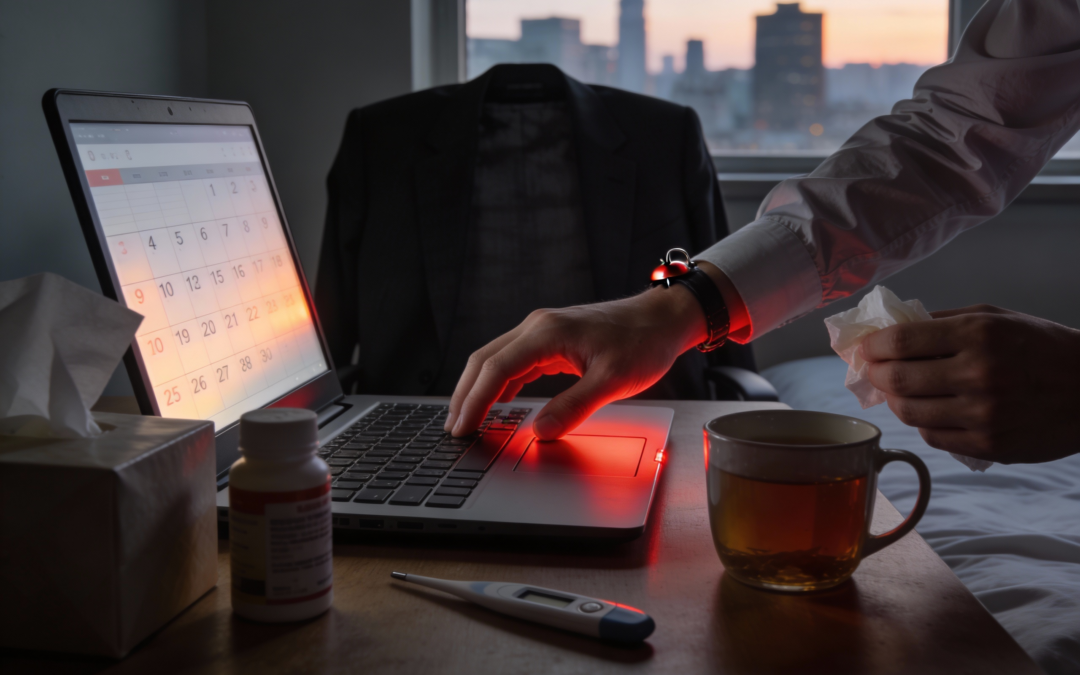
And I’m watching high performers respond the same way they always do: power through it.
Show up sick. Work from bed. Dose up on DayQuil and pretend the body is optional equipment.
After 500+ client check-ins with people who run teams, close deals, and manage million-dollar projects, I’ve learned this:
The executives who brag about powering through sickness aren’t tough. They’re pre-loading their sick days.
Your immune system doesn’t care about your Q1 targets. When you ignore the early warning, the bill comes due with interest.
The Presenteeism Tax You’re Already Paying
Working while sick costs the U.S. economy $150 billion annually in lost productivity.
That’s not absenteeism. That’s presenteeism. Showing up impaired.
Research analyzing 3,258 employees found that distraction contributed to 93.6% of annual productivity loss, with losses from working while sick running roughly three times higher than actual absences.
Translation: you think you’re being productive. You’re operating at one-third capacity while spreading germs to 50% of commonly touched surfaces in your office.
I see this pattern in client check-ins constantly.
Someone pushes through a “small cold.” Training suffers. Sleep gets worse. Appetite goes sideways. Stress reactivity spikes.
Two weeks later they’re still dragging, wondering why their body won’t cooperate.
The body was cooperating. It was sending signals. You kept overriding them. The deadline felt more urgent than the immune response.
The Body Ledger Goes Red Before You Notice
I call this the body ledger. Every skipped meal, every four-hour sleep night, every workout traded for a deadline is debt.
And the interest rate is brutal.
The debt compounds like this:
Sleep debt raises your daily operating cost. A couple of five-hour nights doesn’t make you tired. It makes everything harder. More caffeine to feel normal, worse decision-making late in the day, recovery slows down, stress reactivity goes up.
Chaotic eating creates energy volatility. When meals become coffee plus meetings plus random snacks, your energy becomes a roller coaster. You crash mid-day. You get reactive at night. Training feels impossible.
Skipped training erodes structural resilience. When strength work disappears for weeks, you don’t pause progress. You lose capacity. Everything feels harder when you return. Soreness spikes. Little aches show up.
Unmanaged stress keeps your nervous system stuck on. If you never discharge stress, your body treats everything as urgent. Sleep gets lighter. Digestion gets weird. Alcohol or scrolling becomes your only downshift.
The interest shows up as time. Everything takes longer. Mood. Less patience, more snapping. Appetite. Cravings louder, satiety weaker. Pain. Aches, tightness, tweaks. Motivation. The idea of doing anything feels heavy.
High performers feel blindsided by this because they think they’re borrowing from health to pay work.
The payback comes as reduced performance everywhere.
Early Warning Signs Your System Is Overdrawn
These show up weeks before a full breakdown:
You’re tired even after sleep. Not acute tired. Persistent fatigue doesn’t respond to rest.
Your workouts feel heavier at the same loads. Warm-ups feel like work. Recovery feels slow. You’re sore longer than usual.
You’re getting more snacky and less satisfied. Cravings up. Grazing up. Especially late in the day when decision fatigue peaks.
You’re more reactive. Small stressors feel big. You have less patience with people you care about.
You’re relying on stimulants and numbing. More caffeine earlier. More screens or alcohol at night to wind down.
You start saying “I need to get through this month.” The ledger is talking. It’s always longer than a month.
When I see these signs in a client, I don’t add more rules. I lower the load. I protect recovery.
The goal isn’t to catch up. It’s to stop the bleeding before your system forces a shutdown.
What Sleep Deprivation Does to Your Immune System
Sleep loss doesn’t make you tired. It jolts your immune system into a stress response.
Even one night of 24-hour sleep deprivation in young, healthy individuals altered the profile of immune cells to resemble individuals with obesity, a condition known to drive chronic inflammation.
The greatest changes showed up in white blood cells known as granulocytes, which lost their day-night rhythmicity. These cells reacted immediately to the physical stress of sleep loss.
Sleep deprivation has been associated with alterations of innate and adaptive immune parameters, leading to a chronic inflammatory state and increased risk for infectious and inflammatory conditions.
Translation: when you’re running on five hours of sleep and trying to power through flu season, you’re not tired. You’re operating with a compromised defense system.
When you add hard training, tight nutrition rules, and high work stress on top of this, you’re not building resilience. You’re stacking stressors on a system already negotiating for survival.
The Cultural Pressure That Makes This Worse
High job demands, stress, and job insecurity drive involuntary presenteeism.
Employees who felt their employers didn’t support them emotionally were 320% more likely to have high presenteeism.
Managers who set a bad example by working when sick encourage similar behavior in their teams. It becomes part of the culture. Makes it harder for anyone to make a different choice.
When employees feel presenteeism pressure, they start to see the organization in a negative light. They interpret it as a lack of care for their wellbeing. Lower satisfaction follows. Greater intent to leave.
I’ve had clients tell me they feel guilty taking a sick day. Their boss shows up with a 102-degree fever and acts like it’s a badge of honor.
That’s not leadership. That’s modeling dysfunction.
The cost isn’t individual. If a sick employee’s health condition worsens from lack of timely treatment, the organization needs to grant a longer leave on top of compensation. Associated costs increase.
Working through illness to comply with excessive demands makes strain and illness worse. The risk of further presenteeism increases. So does the likelihood of sickness absence over the longer term.
You’re not saving time. You’re borrowing it at a terrible interest rate.
What Protects Performance When Everyone Around You Is Dropping
When a client is fighting off something or recovering from being sick, I do this:
Training becomes minimum effective. Short strength sessions. Lower volume. No “destroy yourself” workouts. The goal is to feel better and recover, not train harder.
We stabilize one real meal. Usually lunch or dinner. Protein plus produce. Something that stops the grazing and reactive eating.
We add a sleep anchor. Consistent wake time plus a shutdown cue. Even 10 minutes of wind-down routine signals your nervous system you’re done.
We simplify expectations. Fewer targets. Clearer defaults. Success becomes consistency under load, not optimal performance.
When sleep is unstable, everything becomes a willpower fight.
Meal choices get reactive. Training becomes all-or-nothing. Stress reactivity goes up. Planning goes down.
The plan fails. It’s asking for executive-function output from a depleted system.
Sleep is infrastructure. The platform your program runs on.
Once sleep comes up even a little, everything else gets cheaper. Better food choices happen with less effort. Workouts feel doable instead of heavy. Consistency feels normal again.
The If-Then Rules That Keep You in the Game
When chaos hits, you shouldn’t have to think. You execute a pre-decided rule.
The if-then rules I use with clients during flu season or high-stress periods:
IF I slept less than six hours or feel cooked, THEN today is a “protect your system” day.
Training becomes minimum effective. Easy strength or a walk. Caffeine has a cutoff. One early bedtime move gets scheduled.
Pushing hard on low sleep turns into cravings. Skipped sessions later.
IF I’m fighting off something or feel run down, THEN I do floor session only.
Two moves. Timer on. Twelve minutes. Goblet squat plus push-ups. Or band row. The win is keeping your chain, not chasing the perfect session.
IF I’m about to order or eat out and I’m tired or rushed, THEN I use default order.
Protein plus produce plus a carb. Chipotle: double chicken, fajita vegetables, salsa, rice. Sushi: sashimi plus rice plus salad. Burger spot: burger plus side salad, fries optional.
No scanning the menu like it’s a test.
IF I walk into the kitchen and I’m snacky, THEN I drink water. Eat protein first.
Not because water is magic. It interrupts your autopilot. Greek yogurt. Deli turkey. Protein shake. Then decide.
IF I miss one day, THEN I don’t make up for it. I return to baseline at the next opportunity.
No punishment workouts. No starvation day. Just next planned session, next normal meal.
This prevents the spiral.
What Changed for Me
I used to be the person who powered through everything.
Pizza at 11pm would’ve triggered the whole chain. “You blew it. Might as well finish the night. Start over Monday.”
I’d try to punish it with extra cardio or a tight food day.
My identity was built on being disciplined. So a slip didn’t feel like a choice. It felt like a character flaw.
The internal shift for me was realizing this:
Consistency isn’t built by perfect days. It’s built by clean recoveries.
I stopped measuring myself by whether I had a mistake and started measuring myself by how fast I returned to baseline.
Two things clicked:
I separated data from drama. Pizza is information. It tells you what happened in your day. Stress, hunger, social life, schedule. It’s not a moral event.
I stopped over-correcting. Over-correction creates the spiral. If you respond to pizza with punishment, you teach your brain imperfection is dangerous. So the next time it happens, you panic.
If you respond with a normal breakfast, a walk, water, and your usual plan, your nervous system learns this: nothing is wrong. We’re fine.
Continuing without drama is a trained response.
There was a version of me who would’ve turned one late-night pizza into a three-day collapse.
I stopped trying to be perfect. Started trying to be unbreakable.
The Real Win During Flu Season
The goal right now isn’t to optimize. It’s to survive with your system intact.
You’re not trying to hit PRs. You’re trying to keep the chain.
You’re not trying to execute the perfect week. You’re trying to execute the floor plan on your worst week.
If your plan only works on your best week, you don’t have a plan. You have a fantasy.
When we build for chaos (shorter sessions, fewer rules, clear defaults, a minimum viable version you still count), people stay consistent.
Not because they got more motivated. The system finally matched reality.
Your immune system doesn’t negotiate with your Q1 deadlines.
But you can build a plan that survives when your immune system demands attention.
That’s the difference between powering through and staying in the game.